Step 3 of 6 in Build AI Apps and Agents.
Technical AIintermediateVideo + quiz
Testing Your AI App Automatically
For engineers who ship language model features.
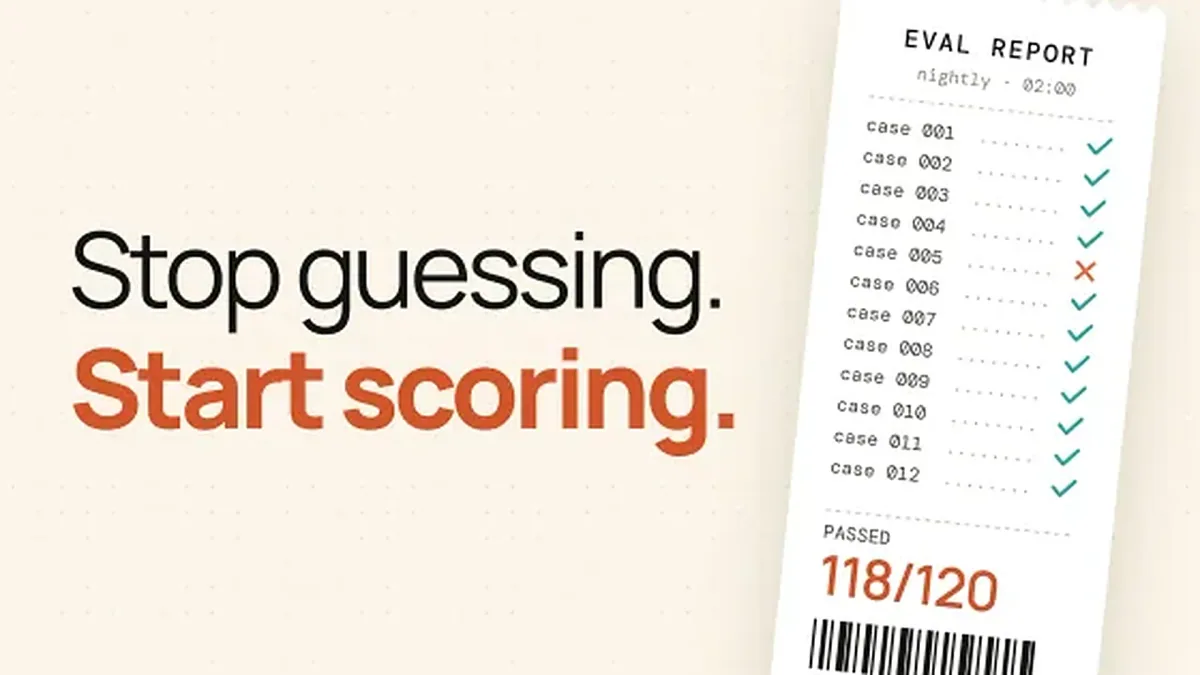 Watch the first lesson freeWelcome · 3 min
Sign in to watch one lesson from this course free.
What you will be able to do
Design an eval harness and build a test dataset that reflects real useGrade outputs with code based checks and calibrated model judgesSet pass and fail thresholds and read the results of repeated runsCompare model versions and spot regressions before they shipRun evals in CI and turn failures into reports the team can act on
Skills you will gain
- Eval Harness Design
- Test Dataset Curation
- Deterministic Grading
- LLM-as-Judge Configuration
- Judge Calibration
- Pass/Fail Thresholds
- Regression Detection
- Model Version Comparison
- Failure Log Analysis
- Diagnostic Reporting
- CI Eval Integration
- Batch API Cost Optimisation
About this course
For engineers who ship language model features. Learn the files of a working eval harness in promptfoo: a labelled test set with a held out split, code based graders and one calibrated model judge, thresholds tied to the cost of failure, version comparison against a baseline, and a build gate with a diagnostic report. Then build a small harness of your own in a hands on lab that runs free on Groq, on Claude Haiku 5.5 if you have API credit, or in mock mode with no key.
Technical AI
Curriculum
Requirements
Node 22.22 or later and a terminal
A free Groq key, Claude credit optional
Comfort reading YAML and JSON
A prompt you want to improve safely
Common questions
Do I need to buy an eval tool before I can start?
No. A minimum viable harness needs only 20 to 50 tasks drawn from your own logs and failures, code-based assertions where possible, and a baseline to compare against; promptfoo, for example, is a free, open-source CLI that runs entirely on your own machine. The dataset, not the tool, is what determines whether a harness catches real problems.
What is the difference between a guardrail and an evaluator?
A guardrail blocks a specific failure inline, at millisecond latency, before an output reaches a user. An evaluator scores quality asynchronously, after the output already exists. Building the wrong one for a given check either adds latency your product cannot afford or lets a harmful output through before anyone scores it.
Should I trust an LLM judge that only ran once?
Not on its own. Research on LLM-as-judge reliability found real limitations in single-sample, greedy-decoded scoring, and found that considering multiple sampled judgments improves alignment with human preferences. The same research found a clear, specific rubric was the single most decisive factor for judge reliability, more so than adding chain-of-thought reasoning.
Is OpenAI's hosted Evals platform a safe foundation to build on right now?
Not for a new project. OpenAI has announced the hosted Evals platform becomes read-only for existing users on 31 October 2026 and shuts down entirely on 30 November 2026, so a harness built there now needs a migration plan almost immediately.
How much human review does an eval harness actually need once it's running?
More than a one-time setup step. A framework drawn from over 100 production AI agent deployments recommends continuously sampling 1 to 2% of production traffic for human verification against the LLM judge's scores, which catches judge drift that a single launch-day calibration cannot.
What you walk away with
A Yallo AI Academy certificate of completion, issued when every lesson is complete and the final assessment is passed at 70% or aboveA public verification page, so a stranger can check the certificate without asking you for a filePDF download, and a one-click share to your LinkedIn profile
Yallo AI Academy certifies completion of
Testing Your AI App Automatically