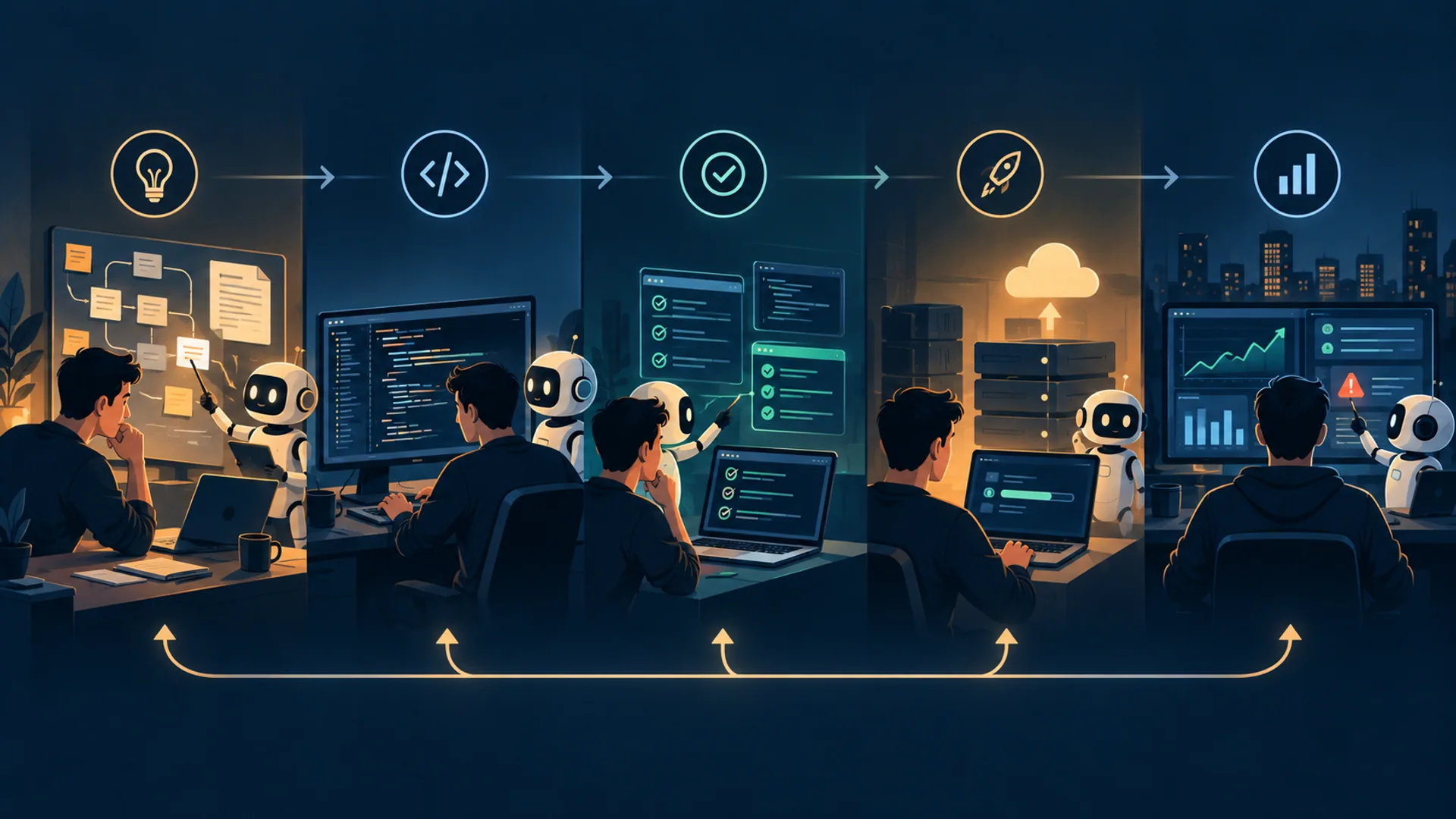
Getting real value out of a coding agent isn't just about writing better prompts. It's a skill that's evolving faster than almost any other part of AI engineering, because the tools themselves, proprietary agents like Claude Code, Codex, and Cursor, and open alternatives like OpenCode and Pi, keep improving on two fronts at once: the underlying model and the harness wrapped around it. Staying current means treating this as an ongoing habit of experimenting and building, not a skill you learn once.
Across conversations with senior AI engineers, and looking at how effective teams actually operate, a consistent pattern shows up. It breaks into three stages.
Planning comes first: brainstorming, researching, understanding whatever codebase already exists, then writing a spec that lays out requirements and technical design before generating an execution plan, often followed by a review pass that checks the plan for security gaps, overengineering, or missing pieces.
Execution comes next, where the agent actually builds, at whatever autonomy level fits the task, with the output verified along the way.
Last is deployment and monitoring, where the agent (sometimes gated by CI/CD or a human checkpoint) ships the work, then watches logs, flags issues, and proposes fixes.
None of this is new in shape, it's roughly the same workflow software teams have always followed. What's different is the balance of effort. Writing code takes up far less of the time now. Deciding what to build, shaping the architecture, and verifying what comes back take up far more. And the workflow isn't linear in practice: a failed verification sends you back to execution, a monitoring alert sends you back to deployment, and knowing when to loop back is itself part of the skill.
Five specific abilities make that workflow work.
Directing the workflow means knowing how to split effort between human and agent at each stage, and understanding the tradeoffs of speed, cost, risk, and effort well enough to decide how much planning a given project actually needs. A quick prototype might get by on a loose prompt, while a production system with real users needs a carefully checked spec.
Enabling agent autonomy means calibrating how much independence to grant on a given task, managing what context the agent carries forward as a build evolves, deciding when to run agents in parallel, and setting the right permissions so speed doesn't come at the cost of safety.
Reviewing the work means designing verification that actually matches the task, automated tests, behavioral checks, screenshots as evidence, LLM-as-judge evaluations where useful, and being honest about when the tests themselves need to change.
Customizing the agent and its environment means maintaining the standing context a codebase runs on: skills, plugins, MCP servers, hooks for repeatable steps, and conventions that keep a codebase navigable to both agents and the humans working alongside them.
Coding agent foundations means actually understanding how the tool works underneath: how it retrieves from a codebase, manages its context window, and hands work to subagents, because that understanding is what lets you recognize a failure mode before it becomes expensive.
There's a popular version of this story that skips straight to autonomy: the agent running for hours unsupervised, burning enormous amounts of compute on a single long task. That happens, and it's sometimes the right call. But as a general strategy, its usefulness relative to its cost gets overstated. What actually works, most of the time, is a tighter loop: plan, build, review, redirect, repeat, with a human re-entering at the moment it matters, not the moment it's convenient.