Large language models have already won gold-medal scores in maths competitions. A new system from Google asks a harder question: can an agent do maths research, not just solve problems someone already knows the answer to.
Key takeaways:
- Google researchers Tony Feng, Quoc V. Le, Thang Luong and colleagues built Aletheia, an agentic workflow for mathematical research powered by Gemini 3 Deep Think.
- Aletheia has contributed to six published papers, ranging from doing essentially all the work to providing minor assistance to human mathematicians.
- Applied to the 700 remaining unsolved Erdős problems, Aletheia claimed solutions to 212 of them.
- Mathematicians checked 200 of those claims: 137 (68.5%) were wrong, 63 (31.5%) were technically correct under some reading of the problem, and 13 (6.5%) were correct as intended.
- Of those 13, 9 turned out to already exist in prior research. Only 4 were genuinely novel.
How Aletheia works
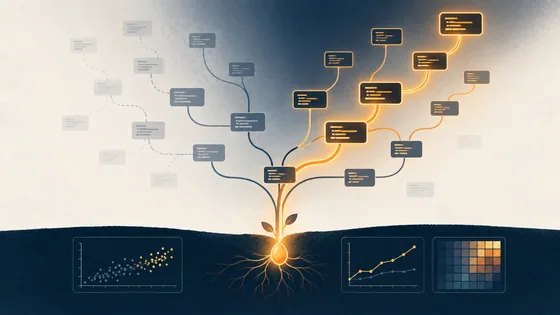
The system runs a three-role loop, all three roles filled by the same underlying model, Gemini 3 Deep Think.
- Generator produces an initial attempt at a solution.
- Verifier checks it and marks it complete, fixable, or critically flawed.
- Reviser takes a fixable solution and the verifier's notes, and produces a revised attempt, which goes back to the verifier.
If the verifier judges a solution critically flawed rather than merely fixable, the loop restarts from the generator with a fresh attempt. This repeats until a solution is marked solved or the process hits a preset limit on model calls.
The Erdős numbers, read honestly
Paul Erdős proposed nearly 1,200 problems between the 1930s and his death in 1996. Fewer than 500 have ever been solved. Aletheia's 212 claimed solutions sound dramatic until you follow them through verification.
| Stage | Count | Share of 200 checked |
|---|---|---|
| Claimed solutions | 212 | — |
| Checked by mathematicians | 200 | 100% |
| Incorrect | 137 | 68.5% |
| Technically correct, ambiguous framing | 63 | 31.5% |
| Correct as intended | 13 | 6.5% |
| Actually novel | 4 | 2% of checked claims |
That funnel, from 212 claims down to 4 genuinely new results, is the real headline. It is not nothing: four new solutions to problems that had resisted solution is a real contribution. But it is a fraction of what the raw claim count implies.
Concept to take away: claims are not results until verified. An agent's own confidence in a solution is not evidence the solution is correct. The gap between 212 claimed and 4 verified-novel is exactly why human review remains load-bearing in any domain where a wrong answer looks, on the surface, like a right one.
What Aletheia is actually good at
The authors' own assessment is specific: Aletheia works best where broad knowledge across many subfields of maths helps more than deep expertise in one. It does not match a human specialist's depth within a narrow subfield. That is a meaningful capability, breadth as a research tool, but a different one from "solving unsolved maths problems" as a headline suggests.
For comparison, this sits in a small but growing category of generalist research agents, alongside Google's own AlphaEvolve, which improved data-centre scheduling algorithms and matrix multiplication methods. Most prior AI-assisted proof work instead used a model to help a mathematician on a specific theorem they were already targeting, a narrower and more supervised use.
Why this matters
Roughly 100 Erdős problems have had AI involvement in their solutions over the past six months alone, a fast pace against a problem set that took human mathematicians decades to chip away at. The right way to read that is not "AI is solving unsolved maths" but "AI is a useful, error-prone collaborator that widens which problems get attempted, provided every claim still goes through the same rigorous check a human proof would."