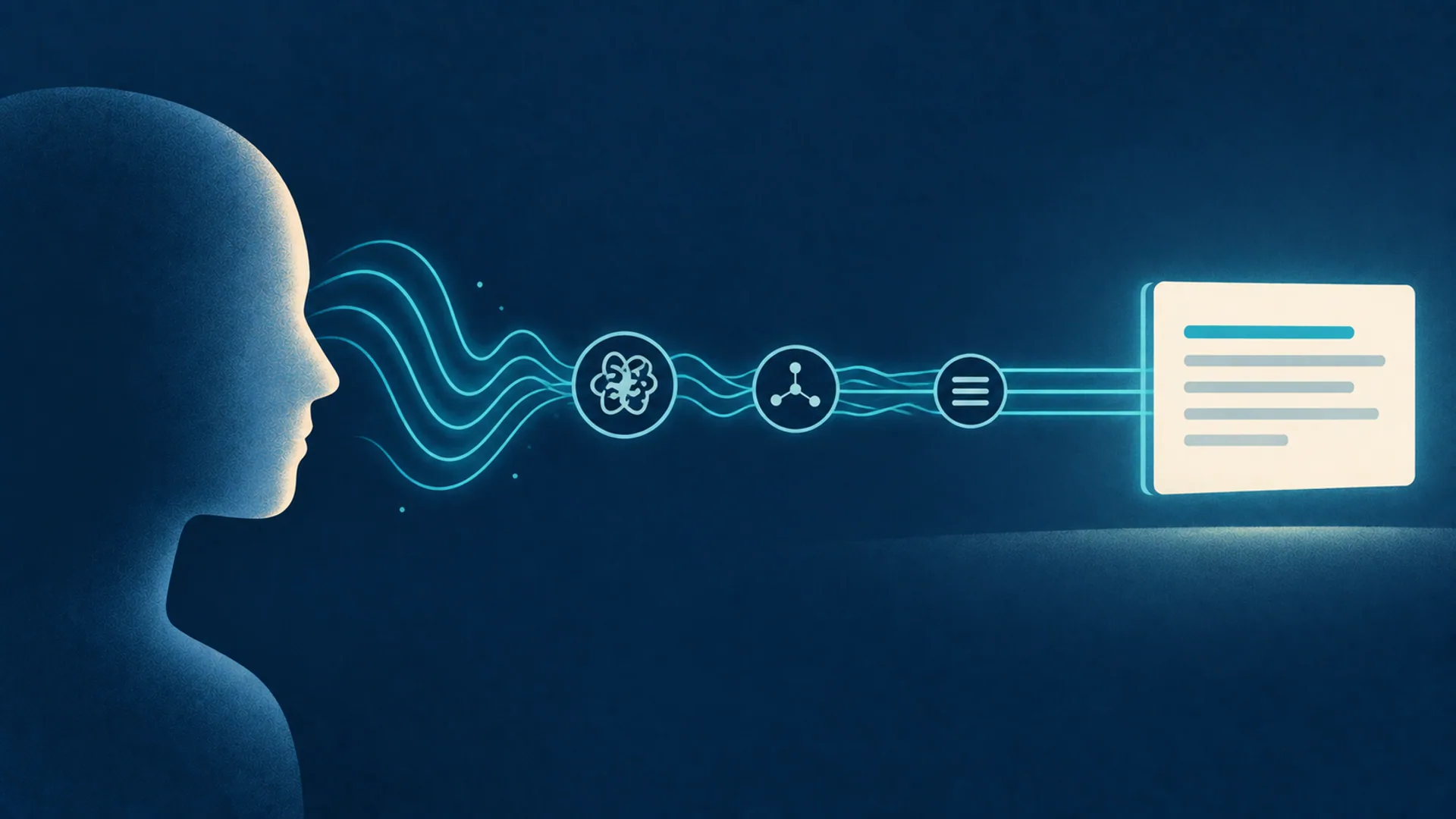
Picture writing a sentence with no keyboard, no joystick, no eye tracker, just a device around your head reading what you meant to type. A team spanning Meta, France's national research centre CNRS, the Adolphe de Rothschild Hospital Foundation, the Basque Center on Cognition, Brain and Language, Paris Cité University and Inria has pushed that idea a meaningful step closer, with a system called Brain2Qwerty v2.
Key takeaways:
- Brain2Qwerty v2 translates magnetoencephalography (MEG) brain recordings directly into typed sentences, in three stages: an encoder, an aligner and a fine-tuned language model.
- Trained on 9 subjects typing sentences, totalling 90 hours and roughly 22,000 examples of recorded brain activity.
- Word error rate improved from 43% in version 1 to 39% in version 2.
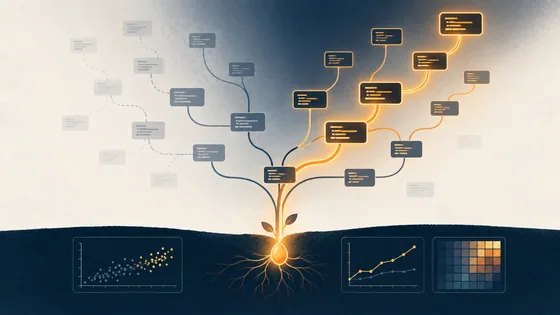
- Character error rate fell from about 50% at 20 hours of training data to about 25% at 90 hours, with no sign of levelling off.
- Training one shared model across all nine subjects beat training a separate model per subject, 47.8% versus 66.5% median word error rate.
How the pipeline works
The system reads brain activity in three handoffs, each doing a narrower job than the last.
- Encoder. A convolutional network paired with a conformer (a CNN/transformer hybrid) turns raw MEG signal into character-level guesses, learning by comparing its guessed character sequence against the real one.
- Aligner. A simple neural network takes those character embeddings, groups them into words using the predicted spaces, and averages them into word embeddings, trained to sit close to the correct word's embedding from Qwen3 and far from the wrong ones.
- Correction. A fine-tuned Qwen3-4B model, adapted per subject using a lightweight LoRA adapter and then averaged across subjects, takes the rough character sequence plus the word embeddings and produces the corrected sentence.
Each stage narrows the error the previous one left behind, so the language model's job at the end is closer to cleanup than to reading minds from scratch.
The result that cuts against intuition
More training data helping is not surprising. What is more interesting is whose data helps. Brain-computer interfaces have historically been trained per person, on the assumption that one person's brain activity does not transfer to another's. Brain2Qwerty v2's data says otherwise: a single model trained across nine people's brain activity performed far better than nine separate models trained one person at a time.
| Training approach | Median word error rate |
|---|---|
| Individual model, per subject | 66.5% |
| Combined model, all subjects | 47.8% |
Concept to take away: shared representations beat isolated ones. This is the same lesson that has driven large language models for years, more diverse data, pooled into one model, tends to outperform narrow data trained in isolation. Seeing it hold for something as individual as a single person's brain activity suggests the same scaling logic may extend further into brain-computer interfaces than researchers expected.
Where this sits against the alternative
Surgically implanted electrodes already let some patients communicate with single-digit error rates, far ahead of Brain2Qwerty v2's 39%. That gap is real and worth stating plainly. But MEG is non-invasive, nobody undergoes brain surgery to use it, and the trend line across two versions and increasing data has moved steadily downward with no plateau yet in sight. Every percentage point closed is a step toward a version of this technology patients could use without taking a surgical risk.
The team has open-sourced the training code for both versions and released the v1 dataset, which gives other labs a direct way to test whether the multi-subject effect holds on new data.