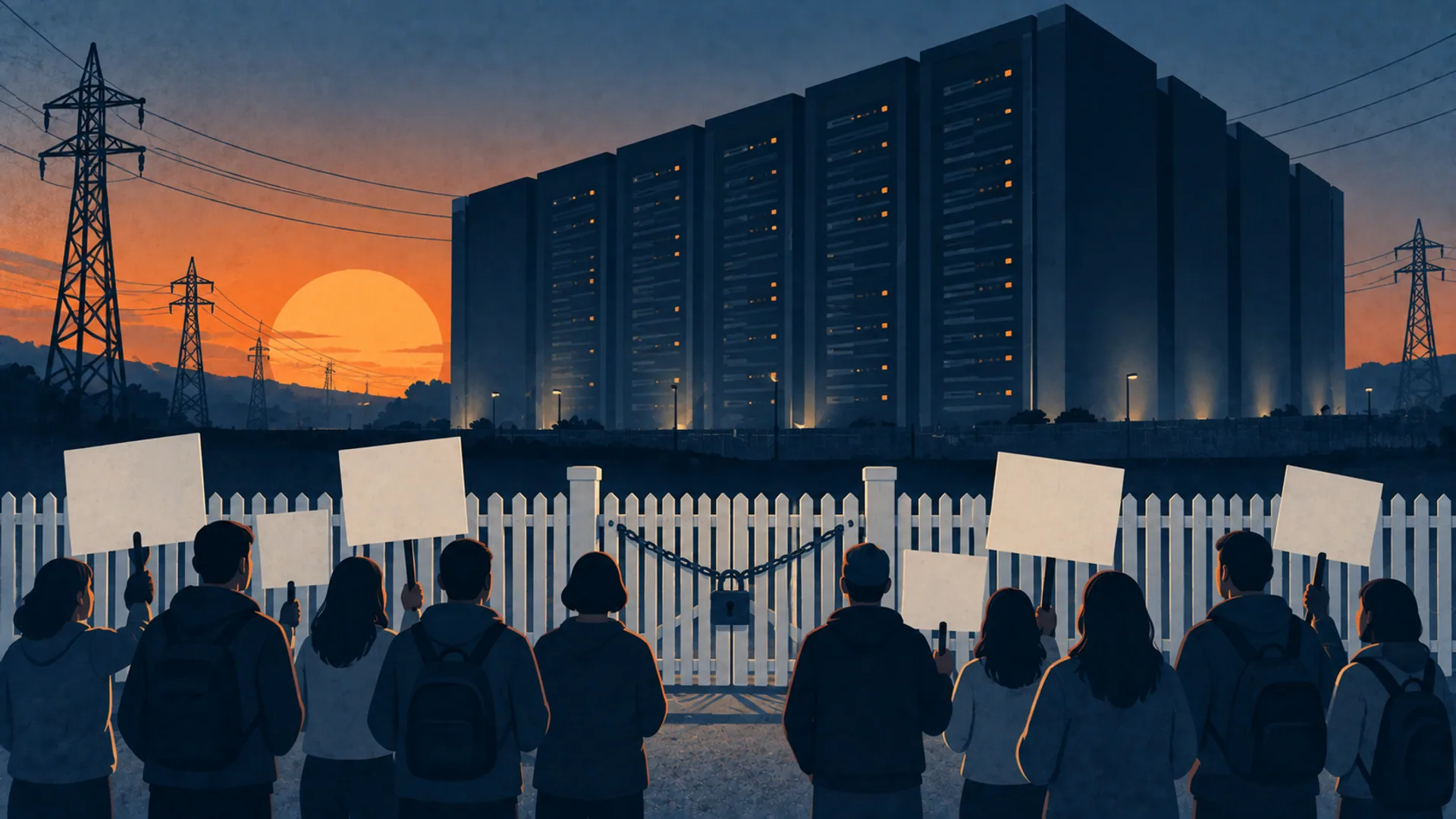
For two years the AI build-out was described as a race for three things: chips, power and capital. In 2026 a fourth constraint surfaced that nobody had priced in. Local permission.
According to Data Center Watch, a tracking project run by the AI research firm 10a Labs, at least 75 data-centre projects worth roughly $130 billion were blocked or delayed by local opposition in the first quarter of 2026. That is the largest single-quarter total since the group began tracking in 2023, and it roughly matches the whole of 2025 in just three months.
Key takeaways:
- Q1 2026: at least 75 US projects worth about $130bn blocked or delayed (Data Center Watch, reported by NBC News, June 2026).
- Active opposition groups more than doubled, from 396 at the end of 2025 to 833 by March 2026, spanning 49 states.
- More than 300 data-centre bills were filed in state legislatures in the first six weeks of 2026; moratorium proposals appeared in 14 states, from both parties.
- A Gallup survey in May 2026 found 71% of Americans oppose an AI data centre near their home.
- On 18 July 2026, 142 coordinated protests took place across 42 states, the first national action against data-centre development.
What is driving the backlash
The grievances are consistent across states, according to the report and the coverage of it:
- Electricity. Concern that data centres push up residential utility bills and strain grids.
- Water. Cooling demands in already stressed regions.
- Noise and air quality. Backup generators and constant hum.
- Jobs. Large facilities employ relatively few people once built, undercutting the economic pitch.
- Secrecy. Non-disclosure agreements around early-stage proposals have eroded trust.
The result is that approvals which would have been a formality two years ago now stretch over months in Virginia, Texas, Indiana and Georgia.
From local fights to state law
The political response has moved fast.
| Measure | Detail |
|---|---|
| State bills filed, first six weeks of 2026 | 300+ |
| States with statewide moratorium proposals | 14 |
| Federal moratorium bill | Introduced by Sen. Bernie Sanders and Rep. Alexandria Ocasio-Cortez |
| Maine | Governor vetoed a statewide permitting moratorium in April, but signed a law barring data centres from state tax incentives |
None of the moratoria has become law as of the report, but the direction of travel is clear: from incentive-focused policy towards regulatory oversight as the energy demands became visible.
Why the industry cannot simply build elsewhere
The obvious response is to move. Some developers are: the report and follow-on coverage note projects relocating to regions with pre-permitted power, including outside the United States. But hyperscaler demand is enormous. Amazon alone announced around $200bn of capital expenditure for 2026, most of it for AWS data centres, and Alphabet guided to $180–190bn. Capacity was already tight, with JLL reporting roughly 1% vacancy in the sector last year. You cannot relocate that much demand quickly.
The build-out has acquired a fourth input nobody priced: "permission to operate."
— Forbes, 22 July 2026
Why learners should care
AI is usually taught as software. This story is a reminder that every model runs on a physical footprint of land, water, electricity and neighbours, and that the binding constraint on the field's growth may turn out to be political rather than technical.
Concept to take away: the physical stack. Under every API call sits a chip, in a rack, in a building, drawing power from a grid, cooled by water, in somebody's county. When you evaluate an AI company's growth plans, ask where the buildings are and whether they have permission.
Note: the $130bn figure is Data Center Watch's own count, not a government statistic. It has been widely reported (NBC News, Newsweek, Forbes, TechRadar) but should be attributed to the group.