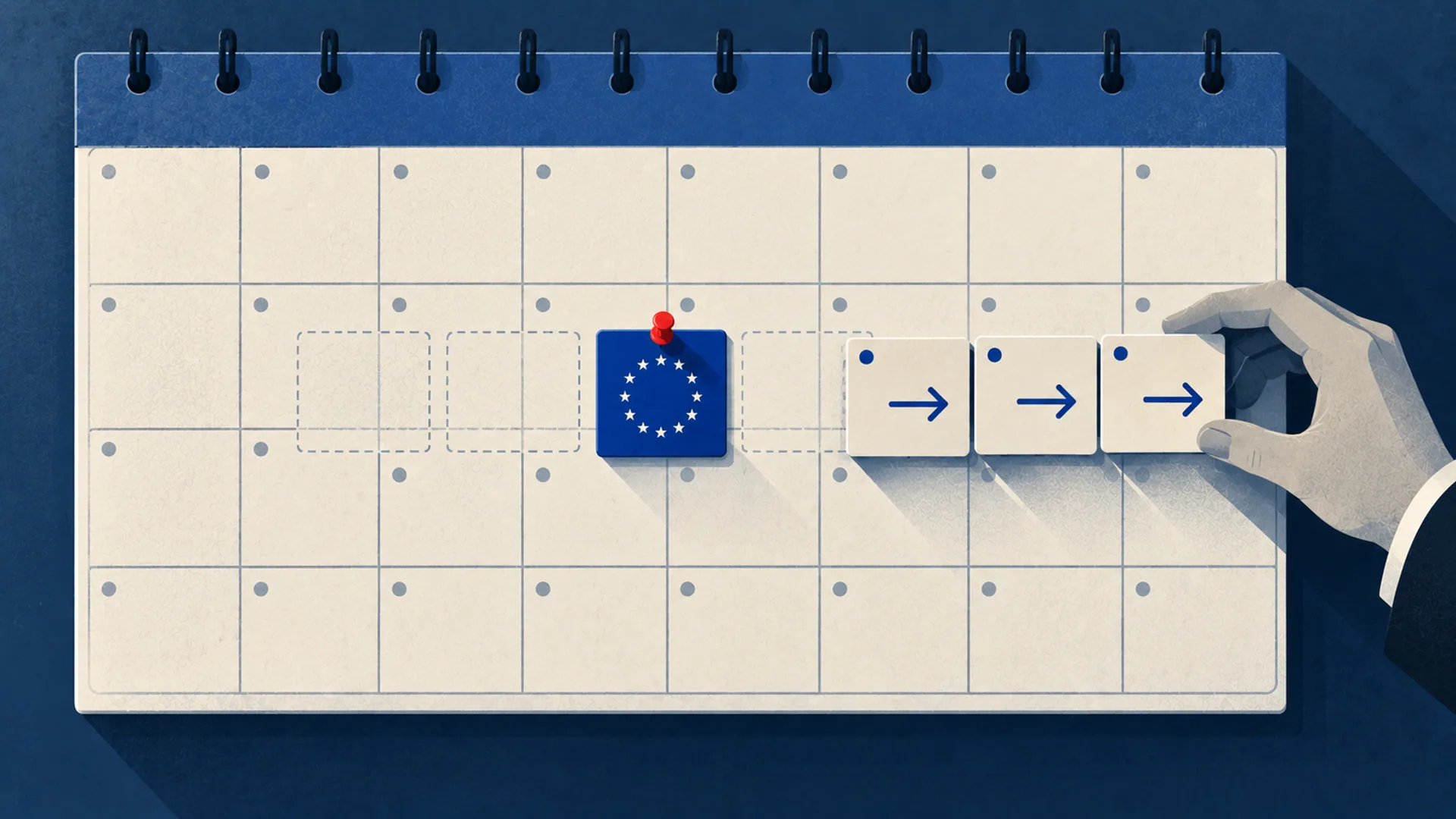
For two years, "the EU AI Act starts biting in August 2026" was the line everyone repeated. On 27 July 2026, six days before that deadline, the European Union changed it.
Regulation (EU) 2026/1744, known as the Digital Omnibus on AI, was published in the Official Journal on 24 July and entered into force on the third day after publication. It is the first amendment to the AI Act since the Act was adopted in 2024. It does not tear up the rulebook. It edits the calendar, narrows a few definitions and eases the load on smaller companies, while leaving the Act's four-tier risk architecture intact.
Key takeaways:
- The Digital Omnibus on AI is now law: published 24 July 2026, in force 27 July 2026.
- Standalone high-risk systems (Annex III: recruitment, education, credit scoring, law enforcement) move from 2 August 2026 to 2 December 2027.
- High-risk AI embedded in regulated products (Annex I: medical devices, machinery) moves from 2 August 2027 to 2 August 2028.
- Not delayed: the Article 50 transparency duties applied from 2 August 2026, the prohibited-practices ban (in force since February 2025) and the general-purpose AI rules (since August 2025).
- New: two additional prohibited practices, SME accommodations, and a softened AI-literacy duty.
How it got here
The Commission proposed the package on 19 November 2025 as part of a wider "Digital Omnibus" simplification drive. Trilogue talks failed on 28 April 2026, then produced a political deal on 7 May. Parliament endorsed it on 16 June, the Council gave its final approval on 29 June, and the text was rushed into the Official Journal in July, explicitly "as a matter of urgency", because the date it amended was 2 August.
One detail matters for anyone planning compliance: the new dates are fixed calendar dates. The Commission's original proposal had tied them to the availability of harmonised standards, which could have pushed them again. Parliament and Council removed that trigger.
The new timeline
| Obligation | Original date | New date |
|---|---|---|
| Annex III standalone high-risk systems | 2 Aug 2026 | 2 Dec 2027 |
| Annex I embedded high-risk systems | 2 Aug 2027 | 2 Aug 2028 |
| Watermarking / content marking (grace period for systems already on the market) | 2 Aug 2026 | 2 Dec 2026 |
| Two newly added prohibited practices | — | 2 Dec 2026 |
| National regulatory sandboxes operational | 2 Aug 2026 | 2 Aug 2027 |
| Pre-existing high-risk systems used by public authorities | 2 Aug 2030 | 2 Aug 2030 (unchanged) |
| Article 50 transparency duties | 2 Aug 2026 | 2 Aug 2026 (unchanged, now live) |
What did not move
This is where most coverage goes wrong. Three sets of obligations are enforceable today:
- Prohibited practices (Article 5): banned since February 2025. The Omnibus adds two prohibitions rather than removing any.
- General-purpose AI model rules: in force since August 2025 for the labs building foundation models.
- Transparency (Article 50): from 2 August 2026, people must be told when they are interacting with an AI system, and synthetic content must be marked. Only a short grace period applies to systems already on the market.
Concept to take away: risk-tiered regulation. The AI Act does not regulate "AI". It regulates uses of AI, sorted into four tiers: prohibited, high-risk, limited-risk (transparency) and minimal-risk. The Omnibus only shifted the high-risk tier. Understanding which tier a system falls into is the first skill in AI governance work.
What changed for smaller companies
The Omnibus writes SME and "small mid-cap" definitions into the Act and attaches concrete relief: a simplified technical-documentation form for high-risk systems, proportionate quality-management requirements, lower caps on administrative fines and priority access to sandboxes.
The AI-literacy duty (Article 4) was also rewritten. It changes from a duty to ensure staff have sufficient AI literacy to a duty to take measures to support its development. It remains binding on every deployer, but it is now an obligation of effort rather than result.
Why learners should care
If you are considering a career in AI governance, compliance, product management or policy, this is the single most useful worked example of how landmark technology law actually lands: in phases, with amendments, and with a gap between what the headlines say and what the text says.
Note: law-firm summaries are useful but secondary. The Commission's own announcement and the Official Journal text of Regulation (EU) 2026/1744 are the primary sources; where trackers disagree, anchor on those.