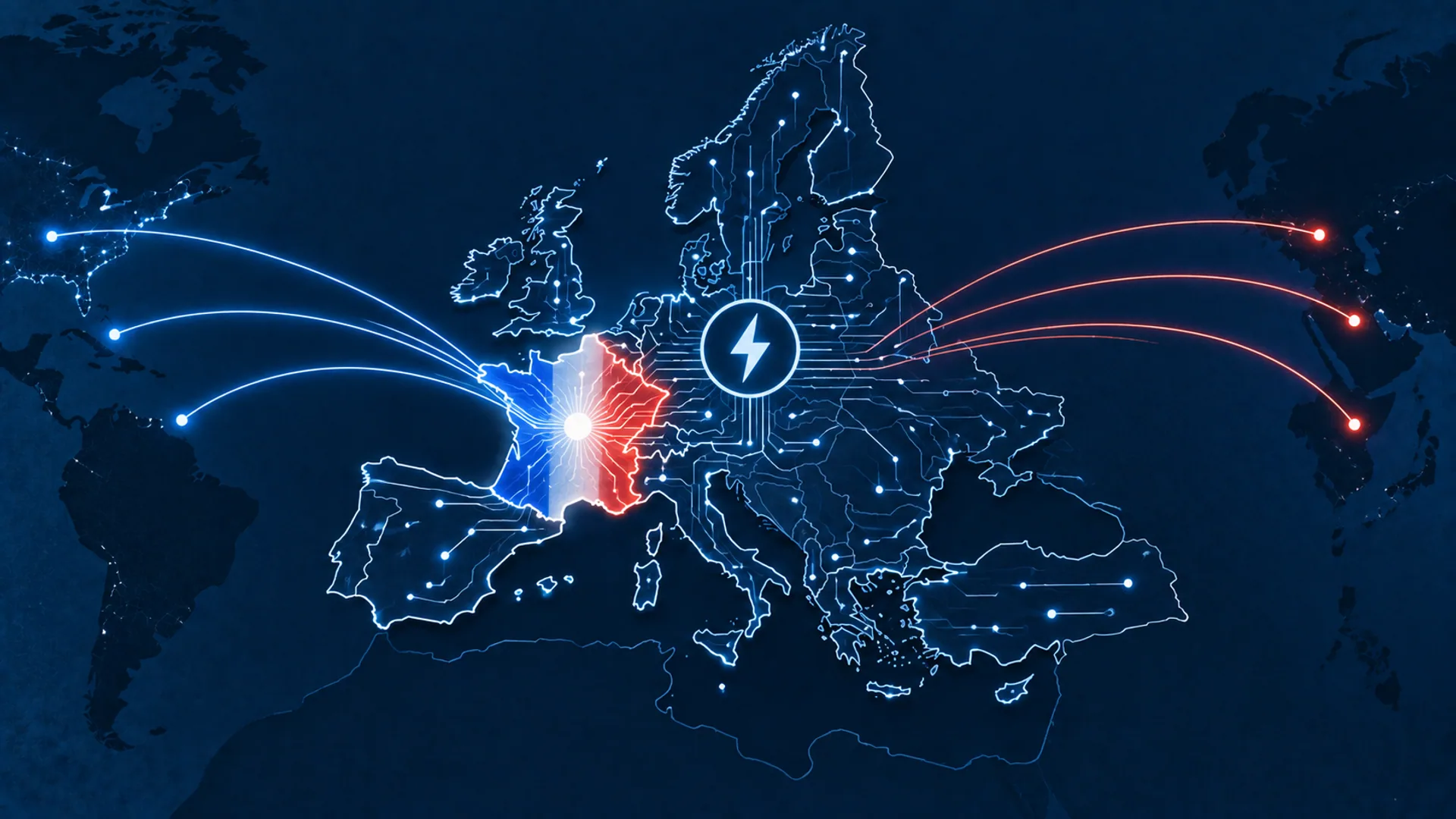
On Tuesday 8 September 2026, Mistral AI confirmed months of rumour: the Paris-based lab has raised €3 billion (about $3.58bn) in a Series D at a post-money valuation of more than €21 billion (about $24.4bn). Mistral calls it the largest equity fundraising round ever completed by a European technology company.
The lead investor is not a Silicon Valley fund. It is Samsung Electronics, with the EQT-managed Scaleup Europe Fund and existing backer PSG Equity as co-leads.
Key takeaways:
- €3bn Series D at a >€21bn post-money valuation, announced 8 September 2026.
- Led by Samsung Electronics; co-led by Scaleup Europe Fund (EQT) and PSG Equity.
- US investors participated too: a16z, Nvidia and Salesforce Ventures returned; Advent and BlackRock joined. The Grand Duchy of Luxembourg is also a new backer.
- Funds go to compute capacity, infrastructure, commercial growth and international expansion; Mistral is targeting 1 GW of European compute by 2030.
- Mistral now operates in 20 countries and expanded its Microsoft partnership in July 2026.
What "sovereign AI" means in practice
The phrase gets used loosely. In Mistral's case it has become a concrete product strategy with three parts:
- Regional inference. In August 2026 Mistral launched tools letting customers choose which geographic region processes their AI queries.
- Model choice. Mistral now hosts third-party open-weight models alongside its own, including Chinese ones, positioning itself as a provider that lets customers control which models they use and how.
- Own compute. A stated goal of 1 gigawatt of compute capacity in Europe by 2030.
The customers are governments and large corporations that want frontier-class AI without depending entirely on US providers, a demand that has intensified as the politics around AI regulation and products in the United States has sharpened.
The geopolitics on the cap table
French President Emmanuel Macron publicly welcomed the round as reflecting France and South Korea's shared aim of building a "third way in AI". Samsung's entry, alongside earlier strategic backing from Dutch chipmaker ASML, gives Mistral industrial partners outside both the US and China.
TechCrunch's analysis is blunt about the arithmetic: the capital needed to compete with leading US labs does not exist in France alone. Mistral's answer is an international cap table with a European centre of gravity, an approach echoed by Germany's Aleph Alpha merging with Canada's Cohere earlier in 2026.
| Detail | |
|---|---|
| Round | Series D, €3bn |
| Valuation | >€21bn post-money |
| Lead | Samsung Electronics |
| Co-leads | Scaleup Europe Fund (EQT), PSG Equity |
| Returning US investors | a16z, Nvidia, Salesforce Ventures |
| New investors | Advent, BlackRock, Grand Duchy of Luxembourg |
| Use of funds | Compute, infrastructure, commercial growth, international expansion |
Not "a European ChatGPT"
Mistral is careful to say its goal is not to build a consumer chatbot rival. Its models have not gone mainstream with the public, and its go-to-market focuses on helping governments and enterprises deploy AI they can control. On Tuesday the company described its frontier research as the foundation underpinning its infrastructure, products and sovereignty, a line widely read as a response to critics who saw its hosting of Chinese models as a drift towards being a mere inference provider.
Mistral still works with US players. Its strategic partnership with Microsoft was significantly expanded in July 2026, aimed at enterprises and regulated industries.
Concept to take away: how to read a funding round. "Series D" tells you the company's stage (fourth institutional round). "Post-money valuation" is what investors think the whole company is worth after the new cash goes in. "Led by" tells you who set the terms. And "use of funds" tells you the strategy: here, compute and infrastructure, not marketing. Funding is not revenue; the Financial Times has reported Mistral's non-US status has helped revenue, but a €21bn valuation is a bet on future sales, not a measure of current ones.
Why learners should care
The AI industry is often presented as a two-horse race between US labs and Chinese labs. Mistral's round is the strongest evidence yet that a third model, European, enterprise-focused and built on control and data residency, can attract frontier-scale capital. For anyone in Europe building a career in AI, it also means a frontier lab that hires locally.