Everyone says AI is transforming science. Far fewer people have checked. A study published in Research Policy in 2026 did, and at scale: more than 80 million scientific publications across more than 170 fields, spanning 2005 to 2023.
The authors, Stefano Bianchini, Enrico Di Girolamo, Julien Ravet and David Arranz, asked two questions. Does using AI make research more novel and more influential? And if so, where?
Key takeaways:
- Dataset: 80 million+ publications, 170+ fields, 2005–2023.
- On average, research that uses AI is more novel and more highly cited.
- The effect strengthened with the arrival of transformers and large language models.
- Benefits are far from uniform: they grow with how deeply AI is embedded in a field.
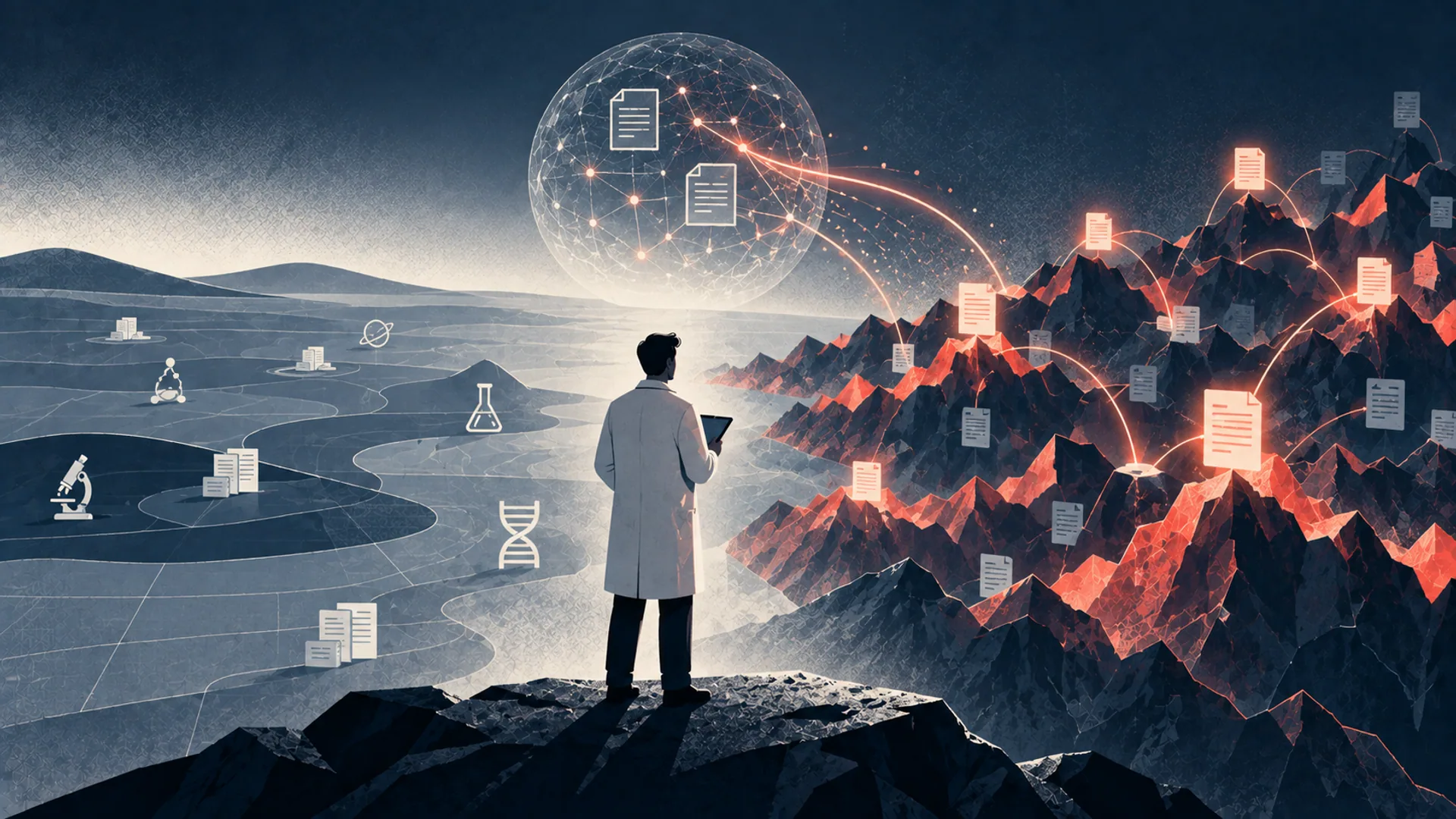
- The biggest novelty gains occur in "rough" knowledge spaces where ideas are fragmented and combinatorially complex.
- Data and code are openly available on GitHub.
What the study measured
Novelty and impact are slippery concepts, so the authors used bibliometric indicators: measures of how unusual a paper's combination of references and concepts is (novelty) and how often it is cited (impact). They then compared AI-using papers against comparable non-AI papers within the same field and period.
This is a correlational design. It cannot prove that AI caused a paper to be more novel. But at this scale, and with the pattern holding across time and fields, it is strong evidence that something real is going on.
The headline finding, and the catch
On average, AI use is associated with more novel and more highly cited work, and that association got stronger after transformers and LLMs arrived.
The catch is in the word average. The study finds two conditions that govern how much a field benefits:
| Condition | What it means | Effect on AI's contribution |
|---|---|---|
| Penetration | How widely AI is adopted and embedded in a field's research practice | Contribution intensifies as penetration rises |
| Roughness | How fragmented and combinatorially complex the field's knowledge is | Strongest novelty gains in "rough" spaces |
Put simply: AI helps most where there are many scattered pieces to connect and where the community has learned how to use it. In smooth, well-mapped fields, the marginal gain is smaller.
A useful counterweight
This study pairs well with a Nature paper from January 2026 by Qianyue Hao, Fengli Xu, Yong Li and James Evans, which found that AI tools expand individual scientists' impact but contract the collective focus of science: researchers pile into AI-friendly problems and follow-on engagement with their results is lower.
Read together, the two studies describe a tension. AI can make your paper more original and more cited. It may also pull the whole field towards the problems AI happens to be good at.
Concept to take away: the "rough landscape" idea. Think of a field's knowledge as terrain. Where it is smooth and well-charted, a fast search engine adds little. Where it is jagged, with many disconnected ideas that could be combined, a system that can read everything and propose connections has real leverage. This is a good mental model for deciding where to apply AI in any domain, not just science.
Why learners should care
- It replaces anecdote with data. "AI is transforming science" becomes a measurable, uneven, field-dependent claim.
- It teaches the difference between correlation and causation in a high-stakes setting.
- It offers a practical heuristic: AI's value is highest where knowledge is fragmented and adoption is mature.