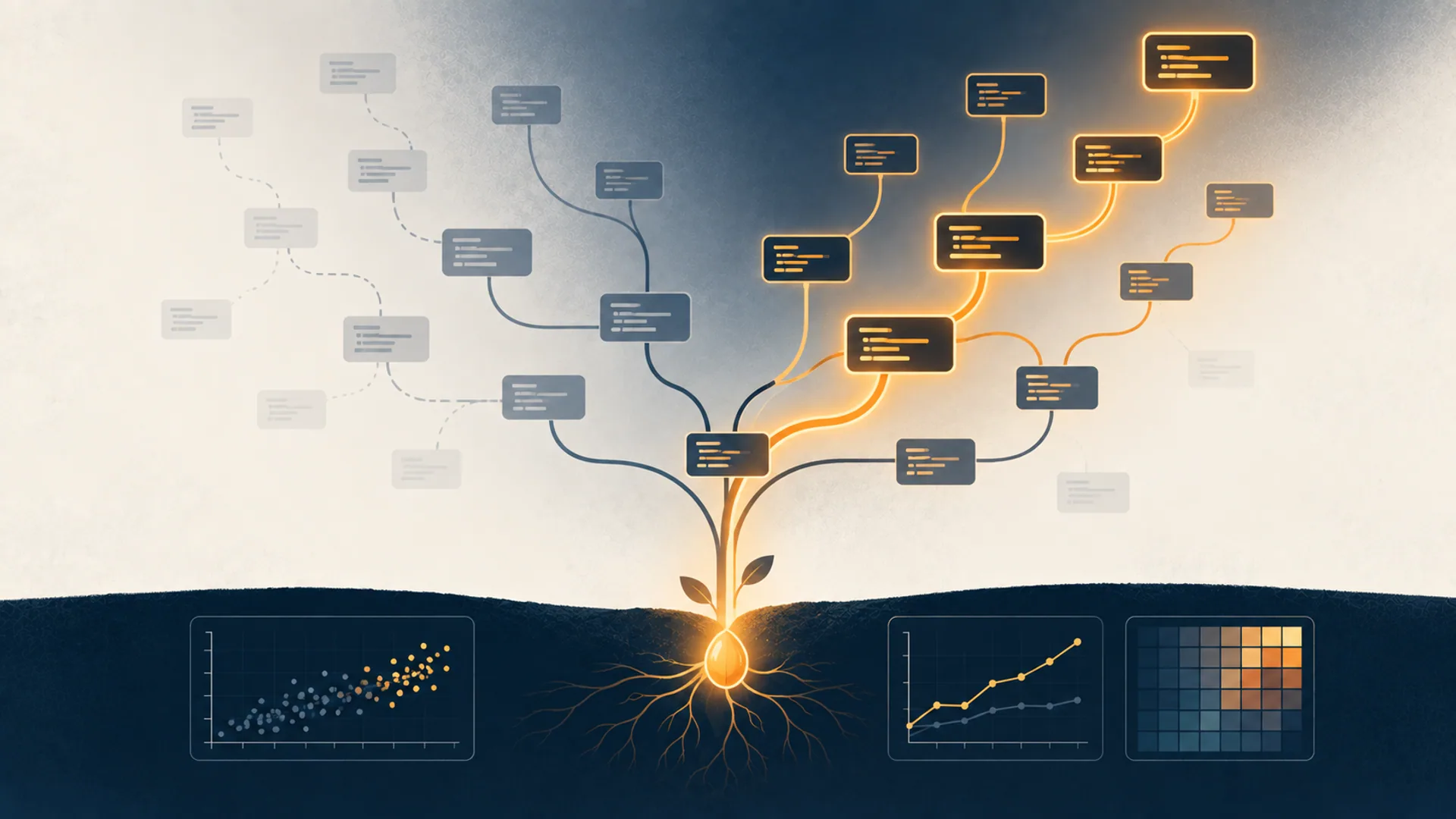
Scientists spend a surprising share of their time not doing science but writing the software that lets them do science: the scripts that clean data, run a simulation or score a model. A paper published in Nature on 19 May 2026 describes an AI system built to take that job off their hands, and to do it at expert level.
The system is called Empirical Research Assistance, or ERA, and it comes from Google. It was one of two Google papers in Nature that week (the other was the Co-Scientist multi-agent system) and both fed into the "Gemini for Science" programme announced at Google I/O 2026.
Key takeaways:
- ERA combines a large language model with tree search to write and iteratively improve scientific code.
- The system optimises a single measurable quality metric for each task.
- In single-cell genomics it produced 40 new methods that beat the top human-built entries on a public leaderboard.
- In epidemiology it generated 14 forecasting models that outperformed the US CDC's ensemble.
- Published in Nature 654, 909–916 (19 May 2026); a preprint had appeared on arXiv in September 2025.
How ERA works
The idea is simple to state and hard to execute.
- Start with a scorable task. ERA needs a task where the quality of a solution can be measured automatically, for example, how accurately a model forecasts hospital admissions.
- Let the language model write a candidate program.
- Score it, then branch. Rather than accepting the first attempt, ERA treats each program as a node in a search tree. It rewrites the code in several directions, scores each new version, and keeps exploring from the most promising nodes.
- Bring in outside ideas. The paper's key finding is that ERA reaches expert level when it explores and integrates research ideas from external sources, such as published methods, rather than only mutating its own code.
- Recombine. Promising approaches from different branches can be hybridised into new methods.
If step 3 sounds familiar, it should. Tree search is the same family of techniques that powered AlphaGo. Here it is steering a code-writing model instead of a game-playing one.
The results
| Domain | Task | Outcome reported in the paper |
|---|---|---|
| Bioinformatics | Single-cell data analysis (OpenProblems v2.0.0 benchmark) | 40 new methods outperforming the top human-developed methods |
| Epidemiology | COVID-19 hospitalisation forecasting | 14 models outperforming the CDC ensemble and all individual models |
| Other | Geospatial analysis and further tasks | Expert-level performance reported across a diverse range |
The authors describe this as the system achieving expert-level results. It is worth being precise about what that means: expert-level on a defined benchmark with a defined metric. It does not mean the system understands biology.
Why learners should care
Three lessons travel well beyond this paper.
Search beats single-shot generation. Asking a model once and taking the answer is the weakest way to use it. Generating many candidates, scoring them and searching the space is how you get reliable quality. This applies to prompting, to agentic coding, to almost everything.
A good metric is half the problem. ERA only works where quality can be scored automatically. Defining that score honestly, without loopholes the search can exploit, is the hard human job that remains.
"AI for science" increasingly means "AI writing code". The frontier is not only models that predict; it is models that build the tools scientists use.
Read the fine print. Leaderboard wins are real but narrow. A method that tops a benchmark can still be brittle on new data, and "outperformed the CDC ensemble" refers to a specific historical forecasting task. Treat these as strong evidence that the approach works, not as proof that the discovered methods are ready for clinical use.