On 19 May 2026, Nature did something unusual: it published two independent research papers describing the same kind of system, and ran an editorial alongside them warning readers not to get carried away.
The systems are Co-Scientist, from Google DeepMind, and Robin, from the non-profit lab FutureHouse. Both are multi-agent AI systems built to speed up the laboratory research cycle. Both made the journal's print cover on 9 July 2026. And both come with the same caveat from their creators: they are designed to work with researchers, not instead of them.
Key takeaways:
- Two multi-agent AI systems for scientific discovery were published in Nature on 19 May 2026.
- Both can generate hypotheses, propose experiments, interpret results and refine their ideas.
- Co-Scientist (Google DeepMind) is built on Gemini 2.0; Robin comes from FutureHouse.
- Early validation focused on biomedicine, including a search for drug candidates for acute myeloid leukaemia.
- Nature's own editorial stresses that AI cannot do good science without humans in the loop.
What a "multi-agent system" means
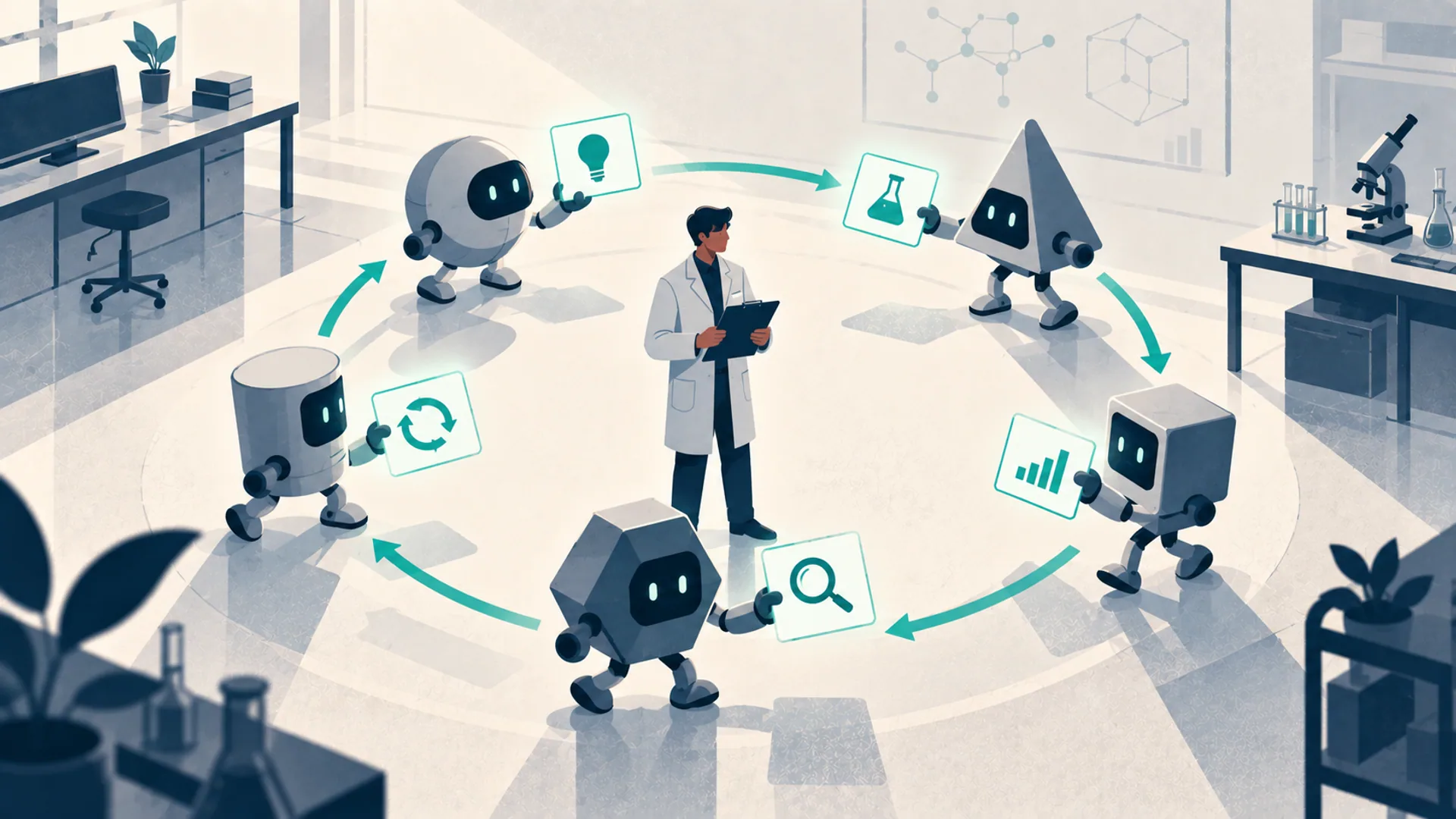
If you have used a chatbot, you have used a single model responding to a single prompt. A multi-agent system is different. It splits a big job into roles and assigns each role to a separate AI agent. One agent might generate ideas, another criticise them, a third rank them, a fourth design an experiment to test the survivors.
The agents pass work between each other, argue, and iterate. The output is not one answer but a refined shortlist, with the reasoning attached.
This is the architecture both papers describe. The scientific method is already a loop, hypothesis, experiment, analysis, and revised hypothesis, so it maps naturally onto a team of specialised agents.
Co-Scientist and Robin at a glance
| Co-Scientist | Robin | |
|---|---|---|
| Developer | Google DeepMind | FutureHouse |
| Underlying model | Gemini 2.0 | Not specified in the summary material |
| Design goal | General-purpose across disciplines | Automating the discovery cycle |
| Early validation | Biomedicine, including a search for acute myeloid leukaemia drug candidates | Biomedical hypothesis generation and data analysis |
| Publication | Nature, 19 May 2026 | Nature, 19 May 2026 |
Both teams stress the same thing: the human scientist stays in control. The AI proposes; the human decides what gets tested at the bench.
Why this is a bigger deal than another benchmark
Most AI-in-science headlines are about one narrow step: predicting a protein structure, say, or classifying images faster. These two papers are about the whole loop. The systems read the literature, propose what to try next, interpret what came back, and adjust.
That matters because the bottleneck in modern research is rarely computation. It is the sheer volume of knowledge a human team can hold in its head at once. A system that can read everything and suggest connections across fields is attacking a different problem from a faster GPU.
The two systems demonstrate the potential of such tools "to improve the scientific discovery process" while assisting, rather than replacing, researchers.
— Nature Portfolio press release, 19 May 2026
The editorial that came with it
Nature did not just publish the papers. It ran a same-day editorial titled "Why AI cannot do good science without humans", plus a news feature on how teams of agents are boosting research speed.
The editorial's argument is worth taking seriously if you are learning AI. Generating plausible hypotheses is not the same as knowing which ones are worth a year of a PhD student's time. Interpreting a dataset is not the same as noticing that the dataset is wrong. Judgement, taste and accountability remain human jobs.
Concept to take away: orchestration. The interesting engineering here is not any single model. It is how the agents are coordinated: who talks to whom, how disagreements are resolved, and where a human checkpoint sits. This is the same design problem you meet in agentic coding tools and enterprise AI workflows.
What to watch next
- Whether either system produces a discovery that is independently validated and published by an outside lab.
- How the "human checkpoint" is implemented in practice, and whether it holds up under pressure to move faster.
- Whether the same architecture spreads beyond biomedicine into chemistry, materials and physics.