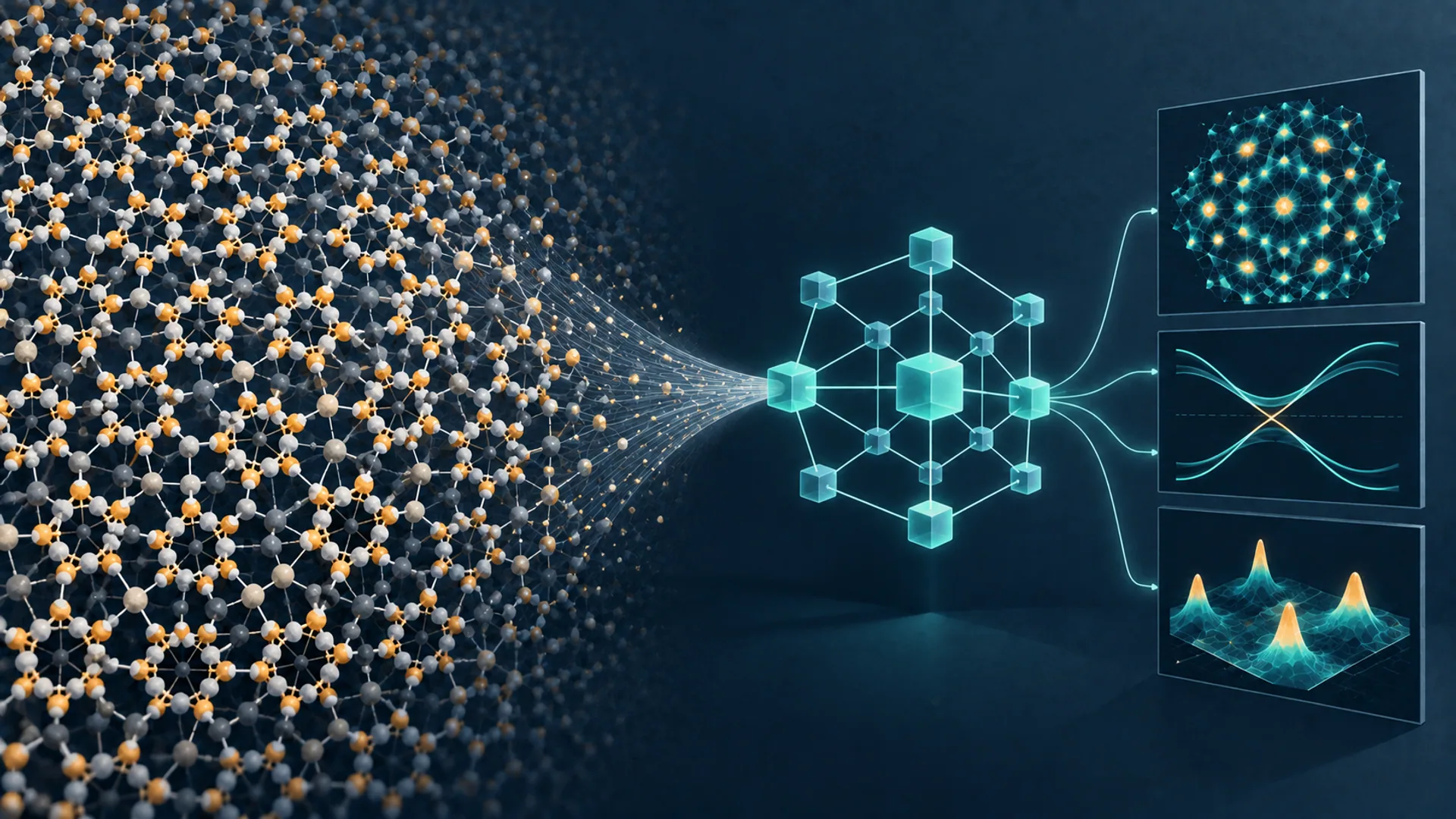
Some of the most promising materials for quantum computers are also the hardest to simulate. Quasicrystals, which have ordered but never-repeating atomic structures, can involve more than a quadrillion numbers to model properly, far beyond any supercomputer.
A team at Aalto University in Finland has published an algorithm that handles them almost instantly, and it does not need a quantum computer to run. The paper, "Tensor Network Method for Real-Space Topology in Quasicrystal Chern Mosaics", appeared in Physical Review Letters on 13 April 2026.
Key takeaways:
- Aalto University researchers (Tiago Antão, Yitao Sun, Adolfo Fumega and Jose Lado) developed a quantum-inspired classical algorithm for simulating non-periodic quantum materials.
- It handled quasicrystals with more than 268 million sites, systems that would require over a quadrillion numbers by conventional methods.
- The method uses tensor networks, a compression technique borrowed from quantum many-body physics.
- Applications: designing topological qubits, superconductors and dissipationless electronics that could reduce data-centre energy use.
- Published in Physical Review Letters, 13 April 2026; widely covered in May 2026.
The problem
Modern quantum-materials research builds structures by stacking and twisting layers. Twist two sheets of graphene by a small angle and the resulting moiré pattern can turn the material into a superconductor. Push further and you reach quasicrystals and "super-moiré" materials whose patterns never repeat.
Predicting which designs will be useful means calculating their electronic and topological properties. Because the pattern never repeats, there is no small repeating unit cell to exploit. The calculation scales with the whole structure, and the whole structure is enormous.
The idea: compress the problem
Tensor networks are a way of representing a very high-dimensional object as a network of small, connected tensors, storing only the structure that matters and discarding redundancy. They originated in quantum physics as a way to describe entangled systems without writing down every coefficient.
The Aalto team's insight is that the same machinery can represent functions defined on ultra-fine spatial grids, which is exactly what a quasicrystal's electronic structure is. Instead of storing a quadrillion numbers, the algorithm stores a compact network that encodes them.
| Approach | What it stores | Practical limit |
|---|---|---|
| Direct simulation | Every value on the grid | Overwhelms supercomputers at quasicrystal scale |
| Tensor-network method | A compressed network encoding the grid | 268 million+ sites, near-instant on ordinary hardware |
The researchers describe the method as "quantum-inspired": it borrows ideas from quantum computing to make a classical computation tractable, rather than running on quantum hardware.
Why it matters beyond physics
Jose Lado, who led the work, points to a feedback loop: better algorithms enable the design of new quantum materials, which in turn enable new kinds of quantum computers, which enable better algorithms. The team also notes a more immediate payoff. Materials that conduct electricity without dissipation could cut the heat and energy demands of AI data centres.
Concept to take away: algorithmic leverage. Progress in computing is not only about faster hardware. A change of representation can turn an impossible problem into a trivial one on the same machine. Tensor networks are one example; sparse methods, fast Fourier transforms and dynamic programming are others. Knowing when to change the representation is a core computer-science skill.