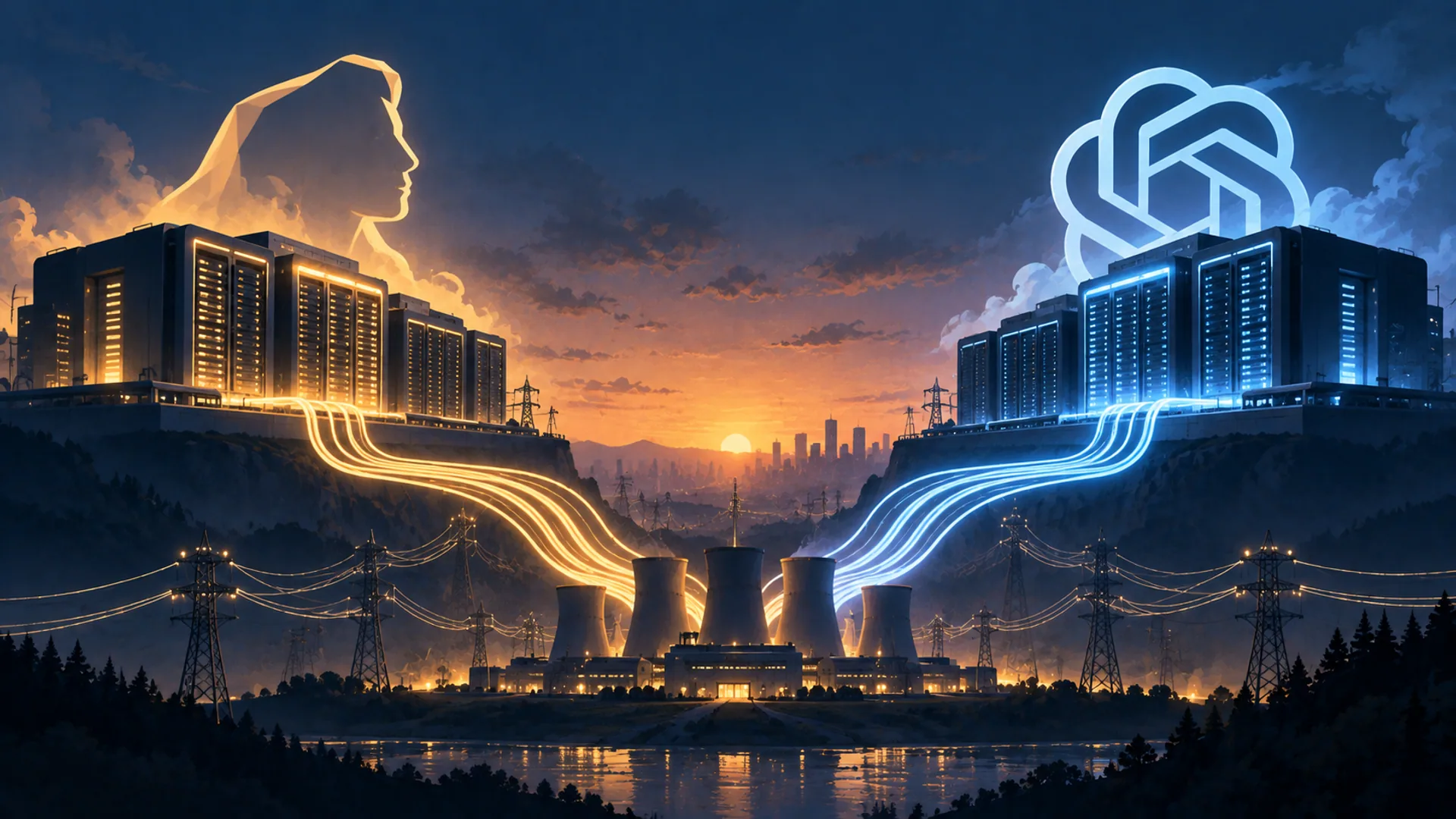
Ask most people what limits how fast AI improves and they will say data, or talent, or compute chips. The honest answer this year has become simpler and much less glamorous. It's electricity. The two companies racing hardest to build frontier models just signed deals that make that plain, and neither deal was primarily about buying smarter algorithms.
What Anthropic just signed. A partnership with AMD to purchase up to 2 gigawatts of AMD's most powerful GPUs, with AMD investing up to $5 billion into Anthropic as part of the arrangement. Hardware is planned to go live in undetermined data centers by 2027, and the two companies may extend the partnership further, with AMD backstopping some construction debt on future sites.
What OpenAI just signed. A 3.2 gigawatt data center in southeastern Georgia, expected online in 2028, with OpenAI leading design and financing directly rather than outsourcing it as it has in the past. Separately, a planned 10 gigawatt data center in southern Ohio would be OpenAI's largest site yet. To offset up to $500 billion in debt on that project, OpenAI may lean on Nvidia to guarantee as much as $250 billion, in exchange for further chip purchases.
| Anthropic + AMD | OpenAI + Nvidia | |
|---|---|---|
| Scale | Up to 2 GW of GPUs | 3.2 GW (Georgia) + 10 GW (Ohio) |
| Financial structure | AMD invests up to $5B in Anthropic | Nvidia may guarantee up to $250B in debt |
| Target online date | 2027 | 2028 (Georgia) |
None of this is happening because anyone ran out of ideas for better training runs. It's happening because there isn't enough power on the grid to run the ideas they already have. BloombergNEF forecasts that data centers will consume 194 gigawatts by 2035, roughly a fifth of all US electricity, up from about 6 percent today, and even accounting for on-site gas generators, the forecast still shows a 19 gigawatt shortfall.
"Right now we have to make hard decisions on what models we actually train, what products we actually scale." — OpenAI president Greg Brockman, on the current compute crunch
Both companies are also visibly trying to keep this spending off their own balance sheets ahead of eventual IPOs, structuring deals as partnerships and guarantees rather than straightforward debt. That's not free engineering, it's a bet that someone else absorbs the risk if demand doesn't materialize the way the spending assumes. Meta's own data center bonds this week priced at 7.5 percent interest, nearly 3 points above the 10-year treasury, a sign lenders are already pricing in real risk on infrastructure this size.
The efficiency side of the story matters too, even if it gets less attention. Nvidia's approach to power delivery, running higher voltage DC directly to server racks instead of stepping grid power down repeatedly, claims roughly 20 percent efficiency gains and could let a single rack carry ten times the load it does today. That kind of gain buys time. It doesn't remove the shortfall.