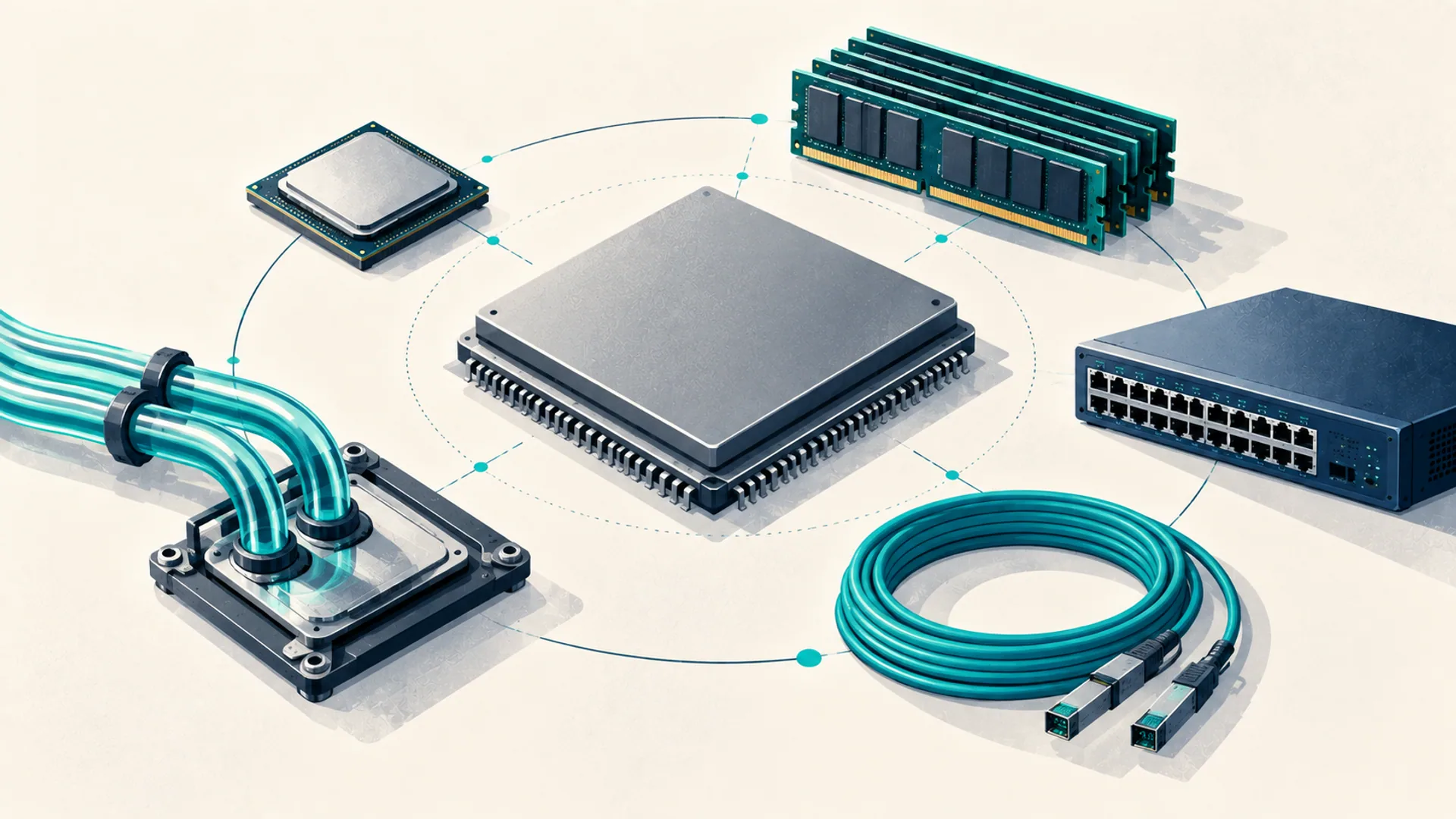
Read the AI hardware headlines and you would think the industry runs on one component. Read the trade press instead and a different picture emerges. Data Center Knowledge's July 2026 hardware roundup barely mentions a flagship GPU. It is about CPUs, networking, memory and the research that will decide what a chip even is in ten years.
Key takeaways:
- AWS Graviton5: Amazon's next in-house Arm-based server CPU, continuing the hyperscaler trend of designing their own general-purpose silicon.
- Qualcomm and Meta: a partnership alongside Qualcomm's new AI data-centre platform, marking a serious push by a mobile-chip company into the rack.
- IBM NanoStack: research into chip architectures below the one-nanometre node, exploring how to keep scaling when conventional shrinking stops.
- Networking: IDC data shows NVIDIA leading the data-centre Ethernet switching market, a reminder that the GPU company is also a networking company.
- The through-line: orchestration software, memory, networking and end-to-end efficiency are now decisive, not FLOPS alone.
Why the CPU still matters
Every AI cluster needs CPUs to run the operating system, schedule work, move data and, increasingly, orchestrate agents. Hyperscalers have concluded that buying these from Intel or AMD is expensive and slow to customise. AWS's Graviton line, now at its fifth generation, is the most mature example; Google and Microsoft have followed with their own designs. Graviton5's arrival is less a product story than a confirmation that the hyperscalers intend to own the whole stack.
Why networking is the hidden battleground
A modern training or inference job spans thousands of accelerators. Moving data between them, fast and without stalls, is the difference between a cluster that runs at 90% utilisation and one that runs at 50%. That is why NVIDIA sells switches and network cards alongside GPUs, and why IDC now records it as the leader in data-centre Ethernet switching, a market once dominated by Cisco and Arista.
For a learner, the lesson is that the network is part of the computer. In AI infrastructure, it may be the most important part.
Why memory is the constraint
High Bandwidth Memory has become the scarcest component in the AI supply chain, and memory capacity and bandwidth increasingly determine what models can be served and at what cost. Intel's decision to build an inference GPU around cheap LPDDR5X instead of HBM (see our Hot Chips piece) is one response to that constraint. Expect more.
Why sub-nanometre research matters now
Chip nodes are named in nanometres, though the names are marketing labels rather than literal transistor dimensions. IBM's NanoStack work asks what happens when conventional scaling runs out: how to stack devices vertically, use new materials and rethink the architecture so that performance keeps improving without smaller transistors. It is a decade-scale bet, but the decisions being made now will set the ceiling for the hardware of the 2030s.
| Layer | Who is competing | What decides the winner |
|---|---|---|
| Accelerators | NVIDIA, AMD, Intel, Google TPU, custom ASICs | FLOPS per watt, memory bandwidth, software ecosystem |
| CPUs | Intel, AMD, AWS Graviton, Google, Microsoft | Cost, integration with in-house stacks |
| Networking | NVIDIA, Cisco, Arista, Broadcom | Latency, bandwidth, utilisation at scale |
| Memory | SK hynix, Samsung, Micron | HBM capacity and supply |
| Process technology | TSMC, Intel Foundry, Samsung | Node leadership and yield |
Concept to take away: the bottleneck moves. Optimise one component and the constraint shifts to another. Faster GPUs expose slow memory; faster memory exposes slow networks; faster networks expose scheduling software. Systems engineers spend their careers chasing the moving bottleneck. Learning to ask "what is the limiting factor now" is more useful than memorising any single spec sheet.
Why learners should care
If you are heading into infrastructure, cloud, DevOps or ML engineering, this is the mental model that will serve you longest: AI runs on a stack, every layer has its own competition, and the flashiest layer is rarely the one that is currently holding everything back.
Note: this is a curated industry roundup from a reputable trade publication. For any single claim, chase the underlying primary source (AWS, Qualcomm, IBM or IDC).