Humanoid robots are the most photogenic story in hardware, and the hardest to fact-check. Investment banks project a market worth tens of billions; keynote demos show robots folding laundry; social media circulates claims of tens of thousands of units in service. A closer look at company filings and earnings calls in mid-2026 tells a more careful story.
Key takeaways:
- Tesla Optimus: Tesla has never published a production count. Its Q1 2026 call (22 April) said production would start at Fremont in "late July or August" on the former Model S/X line; its Q2 update said lines were being installed and production would start "soon". Musk has warned initial output will be "quite slow".
- Boston Dynamics Atlas: shipping its electric Atlas to Hyundai factories in 2026, with plans for a facility capable of 30,000 units a year.
- Figure AI: valued at $39 billion, with an active pilot deployment at BMW.
- Agility Robotics: with Figure, holds the strongest verified deployment records.
- Unitree: ships more humanoids than any Western competitor at roughly a tenth of the price, yet its Q1 2026 profit halved.
- The most recent credible independent estimate of cumulative Optimus builds is in the low hundreds.
Tesla: the conversion of Fremont
Tesla ended Model S and Model X production at Fremont in early May 2026, closing a 14-year run for the S, and began converting the line to build Optimus. The first-generation line is designed for a capacity of one million robots a year; a second-generation line at Giga Texas targets ten million a year in the long term, with production there expected around summer 2027.
Those are capacity targets, not output. On the Q1 call Musk said Optimus has 10,000 unique parts on an entirely new production line and called the 2026 production rate "literally impossible to predict". By the Q2 update in late July, Tesla said it was "installing the first-generation lines" and would start "soon". Early units go to an internal "Optimus Academy" for training data, not to customers. Optimus is not for sale; any offer to pre-order one is a scam.
| Company | Status (mid-2026) | Verifiable? |
|---|---|---|
| Tesla Optimus | Production start pending at Fremont; no unit count disclosed | No |
| Boston Dynamics Atlas | Shipping to Hyundai factories; 30,000/yr plant planned | Partly (parent-company statements) |
| Figure | BMW pilot; $39bn valuation | Yes (published deployment data) |
| Agility Robotics | Logistics deployments | Yes (published deployment data) |
| Unitree | Highest shipment volume; Q1 2026 profit halved | Yes (financial disclosures) |
Why this generation is different anyway
Scepticism about numbers should not obscure what has genuinely changed. Earlier humanoids were hand-programmed for specific motions. The 2026 generation is controlled by vision-language-action foundation models trained on demonstration data, so a robot can be shown a task rather than coded for it. Tesla's AI5 chip, Figure's Helix model and NVIDIA's GR00T platform are all bets on this approach. It is why the hardware can be similar across companies while the software race is wide open.
The hardware constraints nobody demos
- Actuators and hands. Optimus V3's hands have 22 degrees of freedom and around 50 actuators. Dexterous hands are the hardest and most expensive component.
- Rare-earth magnets. High-torque motors depend on neodymium magnets, a supply chain concentrated in China and subject to export controls.
- Batteries. Run-time versus weight remains a hard trade-off.
- Cost. Unitree's pricing pressure shows that even the volume leader struggles to make money.
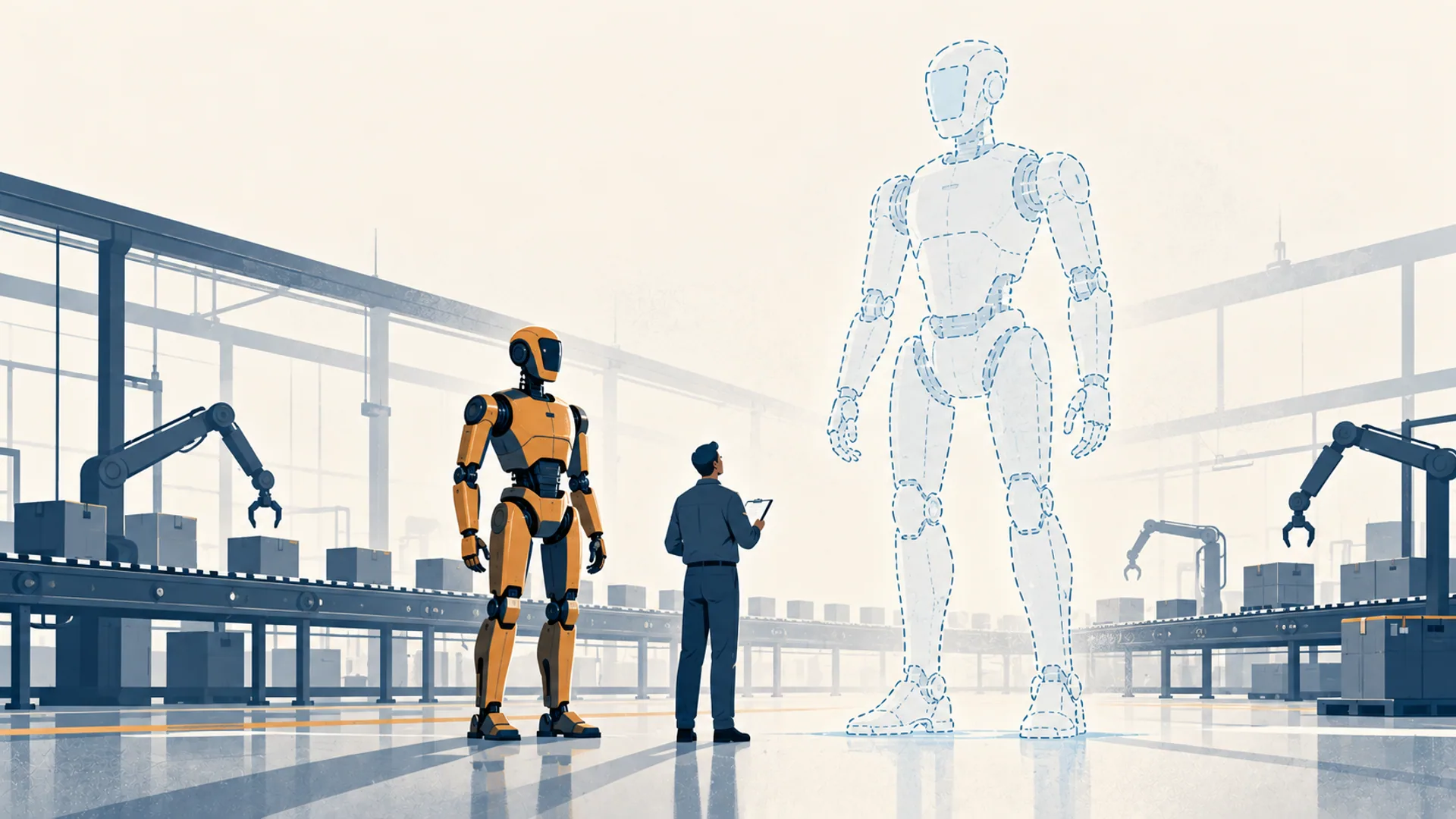
Concept to take away: announced, piloted, deployed, profitable. Those are four different stages, and press coverage routinely blurs them. A factory conversion is not production. A pilot is not a deployment. A deployment is not a business. When you read a robotics claim, ask which stage it describes and whether the company has published a number you can check.
Why learners should care
"Physical AI" is where foundation models meet the real world, and it is likely to be a major employer of robotics, ML and mechanical engineers. Understanding the gap between demo and deployment is the difference between reading the field accurately and being sold to.
Note: figures here come from earnings calls, company statements and trade reporting as of July–August 2026. Tesla's timeline has moved several times; check the latest quarterly update before quoting a start date.