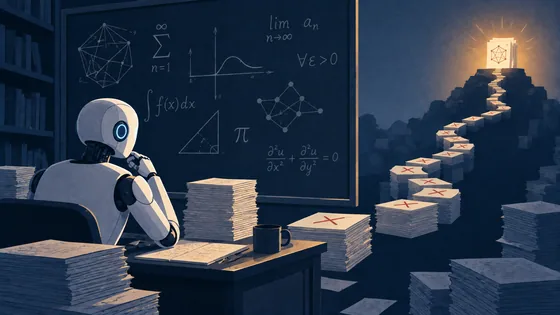
Ask a room of mathematicians how they feel about AI and you will get every answer at once. Some see it as irrelevant to real mathematics. Others fear it will hollow out the creative core of the discipline. A perspective published in Nature on 8 June 2026 argues that both camps are missing what is actually happening.
The authors, Mikhail Burtsev, Yang-Hui He, Evgeny Sobko and Ananyo Bhattacharya of the London Institute for Mathematical Sciences, together with Thore Graepel of Google DeepMind, write from direct experience of using machine learning in pure mathematics and theoretical physics. Their central claim: AI is not replacing human intuition in these fields; it is reshaping how questions are asked, explored and understood.
Key takeaways:
- Nature published a perspective on AI in maths and physics on 8 June 2026 (vol. 654, pp. 324–326).
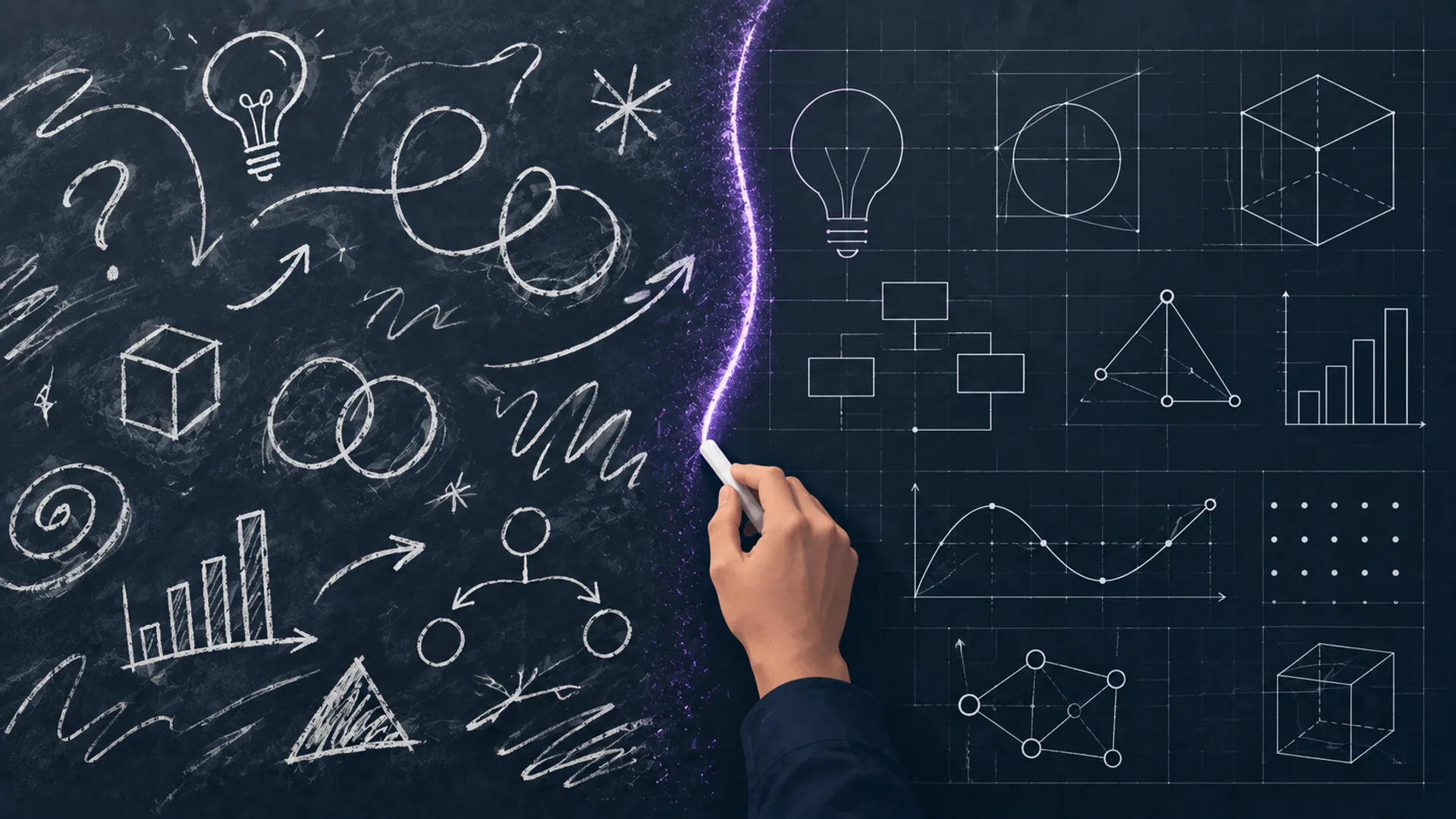
- The authors argue AI is changing the process of discovery rather than displacing mathematicians.
- Machine learning is being used to spot patterns and propose conjectures that humans then prove.
- In the same month, the mathematics community published the Leiden Declaration on AI and Mathematics, a set of principles for responsible use.
- Nature's editors urged other disciplines to follow the mathematicians' lead.
The long history behind the headline
Mathematicians have used computers to hunt for patterns since the 1960s. The Birch and Swinnerton-Dyer conjecture, one of the seven Millennium Prize Problems, emerged from computational experiments on elliptic curves. So the idea of a machine helping to find a conjecture is not new.
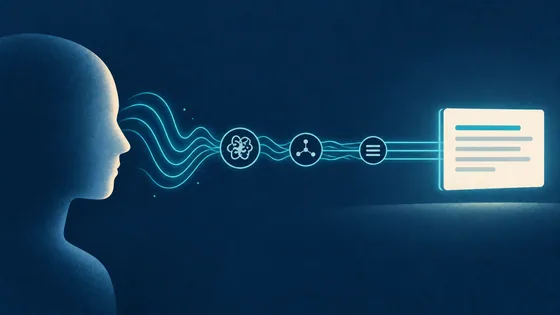
What is new is the scale and the method. Modern machine-learning models can sift enormous spaces of mathematical objects, surface relationships no human had noticed, and, with attribution techniques, hint at why the relationship holds. The human mathematician then does the part machines still cannot: turns the hint into a proof.
The perspective frames this as a workflow:
- Use machine learning to discover candidate patterns and relations.
- Use interpretability tools to understand what the model is responding to.
- Use those observations to guide intuition and propose conjectures.
- Prove them, the old-fashioned way.
Where the caution comes in
The same week's issue of Nature is instructive. Alongside the perspective, the journal ran an editorial (16 June 2026) on the Leiden Declaration on Artificial Intelligence and Mathematics, a set of principles drafted after a meeting in Leiden and published in early June. The declaration recognises the power of AI while insisting that human judgement, transparency and fairness be protected.
Nature's editors went further, arguing that mathematicians are developing rules for AI use and that other fields should follow.
The mathematics community has "initiated an important conversation" about AI, and the discussion should now widen to other disciplines.
— Nature editorial, 16 June 2026
The Einstein test
If you want a sense of where the real ceiling is, a Nature news feature published on 9 September 2026 poses the question directly: could an AI rediscover relativity from scratch? Demis Hassabis of Google DeepMind is quoted calling it "a good test for AGI."
The feature's own answer is sobering. Current models excel at finding correlations in large datasets. Paradigm shifts of the kind Thomas Kuhn described tend to arrive when data are scarce or anomalous, which is exactly where statistical pattern-finding is weakest.
Why learners should care
If you are studying AI, this is a rare, expert, non-hyped account of what the technology does well and where it stops. Three points to carry forward:
- Pattern-finding and proof are different skills. AI is very good at the first and still poor at the second.
- Interpretability is not a luxury. In mathematics, understanding why a model responds to a pattern is the whole point.
- Governance can come from practitioners. The Leiden Declaration is a model for how a discipline sets its own norms before regulators do.
Note: this is a perspective piece, not a results paper. Treat it as expert opinion informed by practice, and read it alongside the harder-edged benchmark studies elsewhere in this series.